Endergenic Power Generation
Endergenic Generators turn a well-timed pearl catch into energy. Link several generators in a loop and the same pearl can generate FE at every stop. The builds below use RFToolsPower and RFToolsUtility on Minecraft 1.20.1 or later, with a shared redstone clock and automatic pearl replacement.
Video tutorial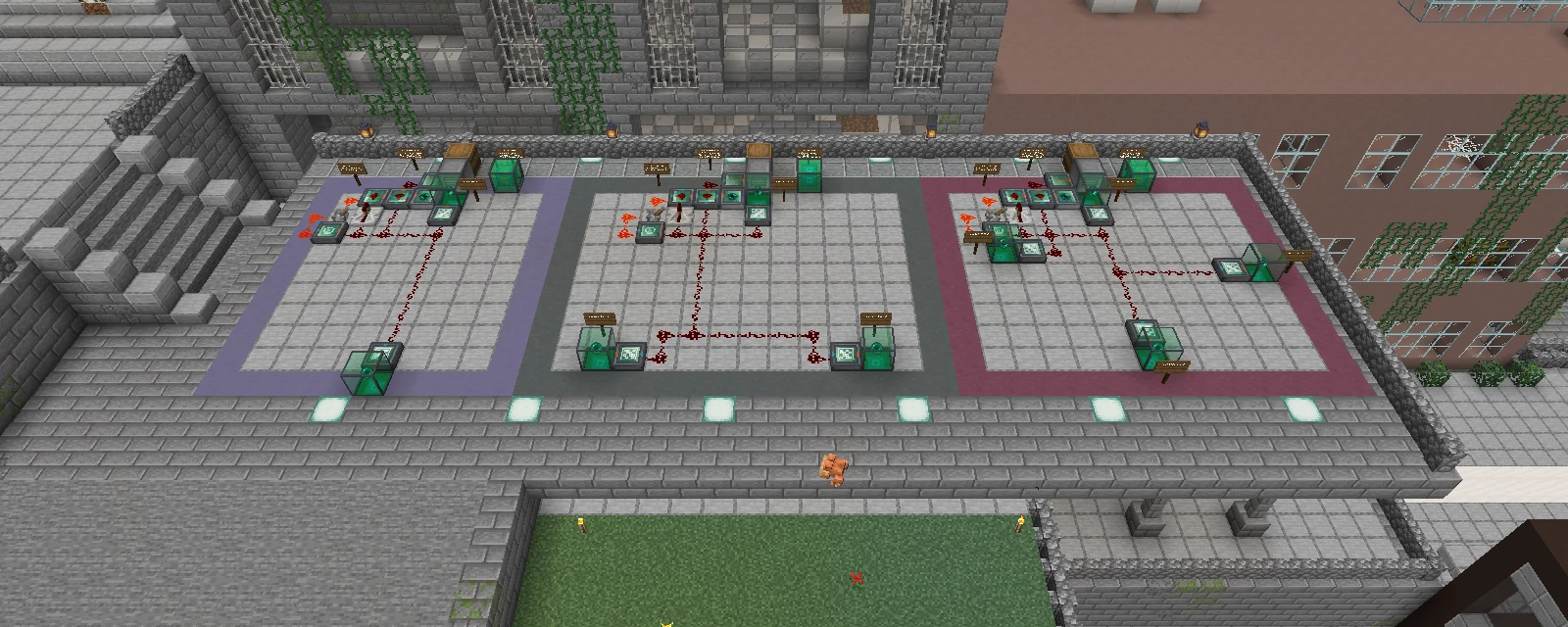
| Generators | Pearl route | Flight times | Clock period | Peak loop rate |
|---|---|---|---|---|
| 2 | A → B → A | 4 + 4 ticks | 15 ticks | ~10,100 FE/t |
| 3 | A → B → C → A | 4 + 4 + 3 ticks | 12 ticks | ~19,200 FE/t |
| 4 | A → B → C → D → A | 3 + 3 + 3 + 2 ticks | 12 ticks | ~25,600 FE/t |
These rates assume fully infused generators, a mature pearl, and space to store or use the energy. The average drops while a replacement pearl builds up its age bonus. The in-game screens label the energy unit RF.
How a generator works
- Idle. The generator waits for a redstone pulse. A pearl arriving in this state is lost. A pulse starts the generator charging at charge tick 1.
- Charging. The generator can catch a pearl on charge ticks 1 through 15. Charging uses no FE. A catch immediately generates energy and moves the generator into Holding. The generator returns to Idle if the window expires before a pearl arrives.
- Holding. The generator keeps the pearl and pays FE for each tick it waits. The next redstone pulse fires it at the linked generator and returns this one to Idle. A held pearl can disappear randomly or when the generator runs out of energy. A second pearl arriving during Holding destroys both.
The charge and fire pulses use the same redstone input. Leave at least one game tick with the signal low between them so both rising edges register. A pulse during Charging leaves the charge counter running.
Aim for charge tick 10
The receiver generates the most energy when the pearl arrives at charge tick 10. The catch pays out immediately. The fire pulse sends the pearl onward.
| Receiver's charge tick | 8 | 9 | 10 | 11 | 12 |
|---|---|---|---|---|---|
| FE per mature catch at full infusion | 38,400 | 48,000 | 76,800 | 48,000 | 38,400 |
A fresh pearl at charge tick 10 produces 38,400 FE at full infusion. Each relaunch adds one point of age and a 5% bonus to the next catch, up to a 100% bonus at age 20. Full infusion adds 50% to each catch and lowers the cost of a paid holding tick from 500 to 333 FE. The same timing works at every infusion level.
Charge tick is the receiver's counter. Flight time is the number of game ticks the pearl spends travelling between two generators. Lap tick is the position in the shared clock cycle. In the three-generator build, for example, A starts charging at lap tick 2, C fires at lap tick 8, and the three-tick return reaches A at lap tick 11, when A's counter reads 10.
Parts and placement
Each build needs one Endergenic Generator and one Sequencer per letter in its loop. It also uses one Pearl Injector, one Ender Monitor, one Timer, two Logic blocks, one RFToolsUtility Wire, one vanilla Redstone Repeater, a Lever, and redstone dust. Bring ender pearls and a Smart Wrench. To export through the shared outlet shown here, add one Advanced Dimensional Cell per generator, one for the outlet, and a Powercell Card for each cell.
- Use a solid floor and place the blocks on one level. The top-down plans
below use A as
(0, 0). X increases east and Z increases south. - Place the injector immediately south of A, with its injection side toward A. On this side of the generator the injector's block facing is south.
- Point each Sequencer's output at its adjacent generator and its input at the dust shown in the plan. On the floor-mounted RFTools logic blocks, cyan marks the inputs and orange marks the output.
- Use the Smart Wrench on the source generator and then on its destination. Repeat for every link, including the last link back to A. Check the travel time in chat. A straight-line distance of 6 to under 9 blocks gives 3 flight ticks, and 9 to under 12 blocks gives 4. A distance of 3 to under 6 gives 2. Diagonal links use straight-line distance too.
- Keep the lever powered while configuring the controls. With Pause while redstone active enabled on the Timer, flip the lever to unpowered to run.
Shared clock and pearl replacement
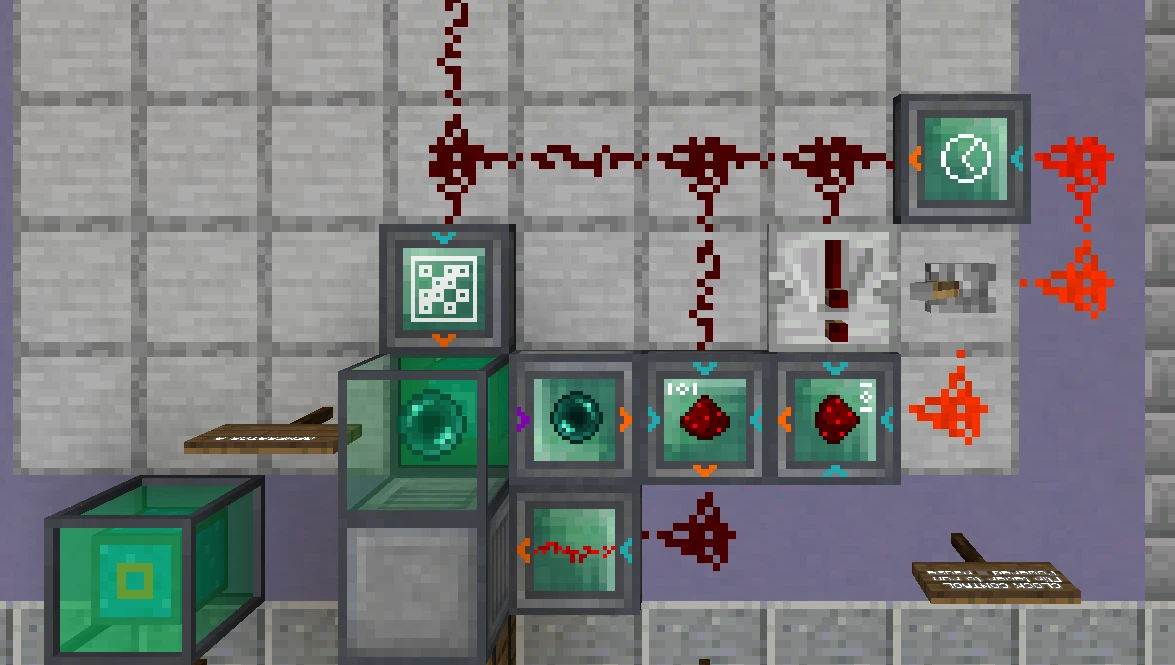
All three plans use the control circuit shown above. Set the Timer to 15 ticks for two generators or 12 ticks for three or four. Its output travels west into the clock dust, which branches to every Sequencer, the injector gate, and the repeater. Set the Ender Monitor to Pearl Fired. Its input faces A and its output faces the injector gate.

| Block | Relative position | Inputs and output |
|---|---|---|
| Timer | (4, -2) | East pause input, west clock output |
| Lever | (4, -1) | Powers the pause dust east and south of it |
| Repeater | (3, -1) | North clock input, south output, shortest delay |
| Startup latch | (3, 0) | North repeater input, east pause input, west output |
| Injector gate | (2, 0) | North clock input, west monitor input, east latch input, south output |
| Ender Monitor | (1, 0) | West input from A, east output to the injector gate |
| Directional Wire | (1, 1) | East input from the gate's dust, west output to the injector |
| Pearl Injector | (0, 1) | Receives the Wire signal, injects into A to the north |
Logic settings
The tables below count the eight GUI rows from 0 at the top. Keep retains
the block's previous output.
| Logic block | On | Keep | Off |
|---|---|---|---|
| Startup latch | Rows 4 and 5 | Rows 0 and 1 | Rows 2, 3, 6, and 7 |
| Injector gate | Row 3 | None | All other rows |
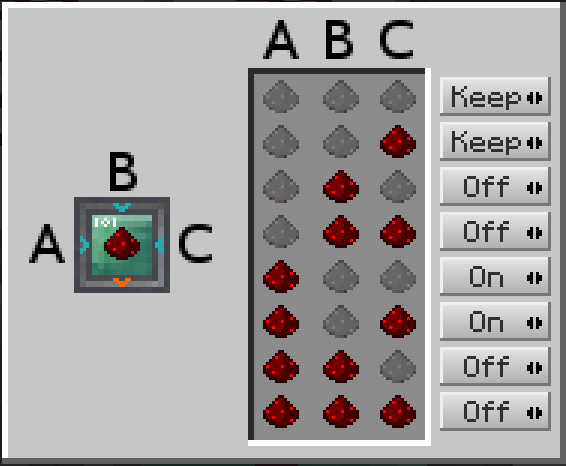
The startup latch remembers the first clock pulse. It clears as soon as the lever powers the pause line. When unpaused, the first pulse runs the Sequencers with an empty loop. The receiving generators are idle, so their first fire pulses start Charging. The repeater delays the latch signal by two game ticks, which keeps the injector closed through the first clock pulse. The second clock pulse releases one pearl. B catches it at charge tick 12, and the regular charge pulses bring it to tick 10 on the following lap.
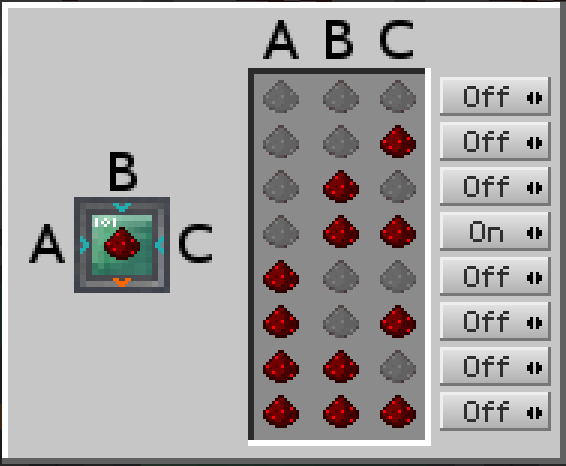
The injector gate releases a pearl only when the clock pulses, the latch is armed, and the monitor stays low. In its GUI, A is the west monitor input, B is the north clock input, and C is the east latch input. On a healthy lap, the Ender Monitor reports A's launch before the Timer updates, so the injector stays closed. If A misses its shot, the injector launches a replacement from A at the start of the next tick. A updates later in that same tick and advances the first tick of flight, so the new pearl reaches B on schedule.
Keep the directional Wire next to the injector. Dust in that spot can also power generator A through the injector block and interfere with A's two pulses.
Sequencer settings
Set every Sequencer to Once2 and Delay 1, and leave End on off. Set Sequence length to the clock period for that build. The Timer restarts every sequence on each lap. Count the squares from 1 at the upper left, with eight per row, and enable only the two squares in the table.
| Build | Length | Generator | Charge square | Fire square |
|---|---|---|---|---|
| Two generators | 15 | A | 2 | 15 |
| Two generators | 15 | B | 9 | 7 |
| Three generators | 12 | A | 2 | 12 |
| Three generators | 12 | B | 6 | 4 |
| Three generators | 12 | C | 10 | 8 |
| Four generators | 12 | A | 2 | 12 |
| Four generators | 12 | B | 5 | 3 |
| Four generators | 12 | C | 8 | 6 |
| Four generators | 12 | D | 11 | 9 |

The Sequencers update after the generators, so a generator acts on a pulse on the next game tick. A's final square makes it fire at tick 0 of the next lap. B, C, and D fire early in their sequences using the charge they started on the previous lap. Their later charge pulses prepare the next catch.
Build layouts
The photos and plans face north at the top. Everything shown sits on the same floor level. An optional input cell sits one block below each generator. The signs and spare-pearl barrels can be placed wherever they are convenient.
| Marks | Blocks |
|---|---|
A–D, S | Generators in pearl travel order, Sequencer |
T, L, R, K | Timer, lever, repeater, startup latch |
M, G, I, W | Ender Monitor, injector gate, Pearl Injector, directional Wire |
*, r, P, . | Clock or injector dust, pause dust, FE outlet, open space |
Two generators
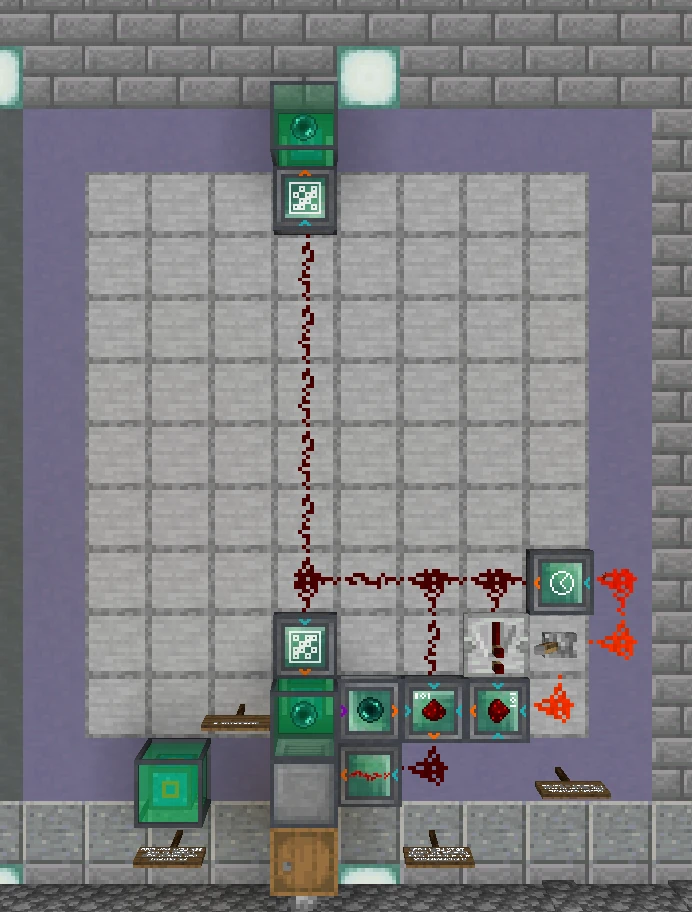
   X  -2 -1  0 +1 +2 +3 +4 +5
 Z
-9     .  .  B  .  .  .  .  .
-8     .  .  S  .  .  .  .  .
-7     .  .  *  .  .  .  .  .
-6     .  .  *  .  .  .  .  .
-5     .  .  *  .  .  .  .  .
-4     .  .  *  .  .  .  .  .
-3     .  .  *  .  .  .  .  .
-2     .  .  *  *  *  *  T  r
-1     .  .  S  .  *  R  L  r
 0     .  .  A  M  G  K  r  .
+1     P  .  I  W  *  .  .  .
Link A → B → A, with 4 flight ticks in each direction. A fires at lap tick 0, B catches at 4 and fires at 7, then A catches at 11 and fires at 15. A starts its next charge at tick 2 and B at tick 9. B pays for three holding ticks before firing and A pays for three on the return.
Three generators
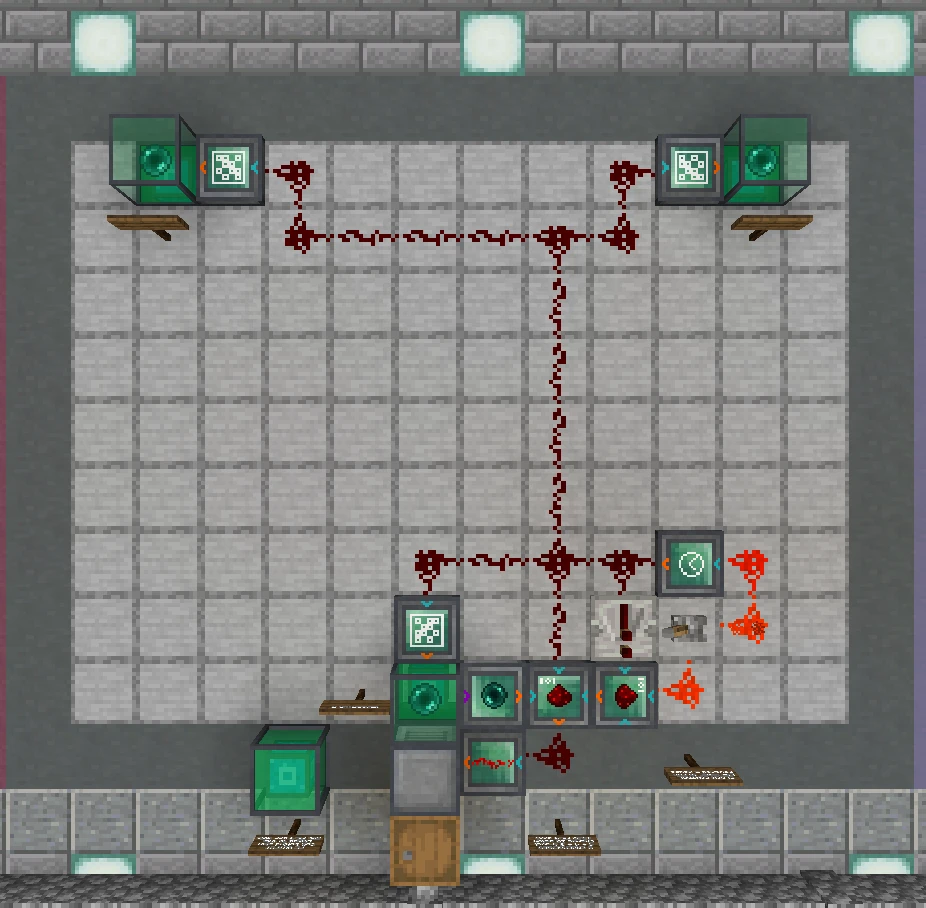
   X  -4 -3 -2 -1  0 +1 +2 +3 +4 +5
 Z
-8     C  S  *  .  .  .  .  *  S  B
-7     .  .  *  *  *  *  *  *  .  .
-6     .  .  .  .  .  .  *  .  .  .
-5     .  .  .  .  .  .  *  .  .  .
-4     .  .  .  .  .  .  *  .  .  .
-3     .  .  .  .  .  .  *  .  .  .
-2     .  .  .  .  *  *  *  *  T  r
-1     .  .  .  .  S  .  *  R  L  r
 0     .  .  .  .  A  M  G  K  r  .
+1     .  .  P  .  I  W  *  .  .  .
Link A → B → C → A with 4, 4, and 3 flight ticks. A fires at 0. B catches and fires at 4, C catches and fires at 8, and A catches at 11. A fires on tick 12. The charge pulses land at ticks 2 for A, 6 for B, and 10 for C. The healthy loop spends no FE holding the pearl between catches.
Four generators
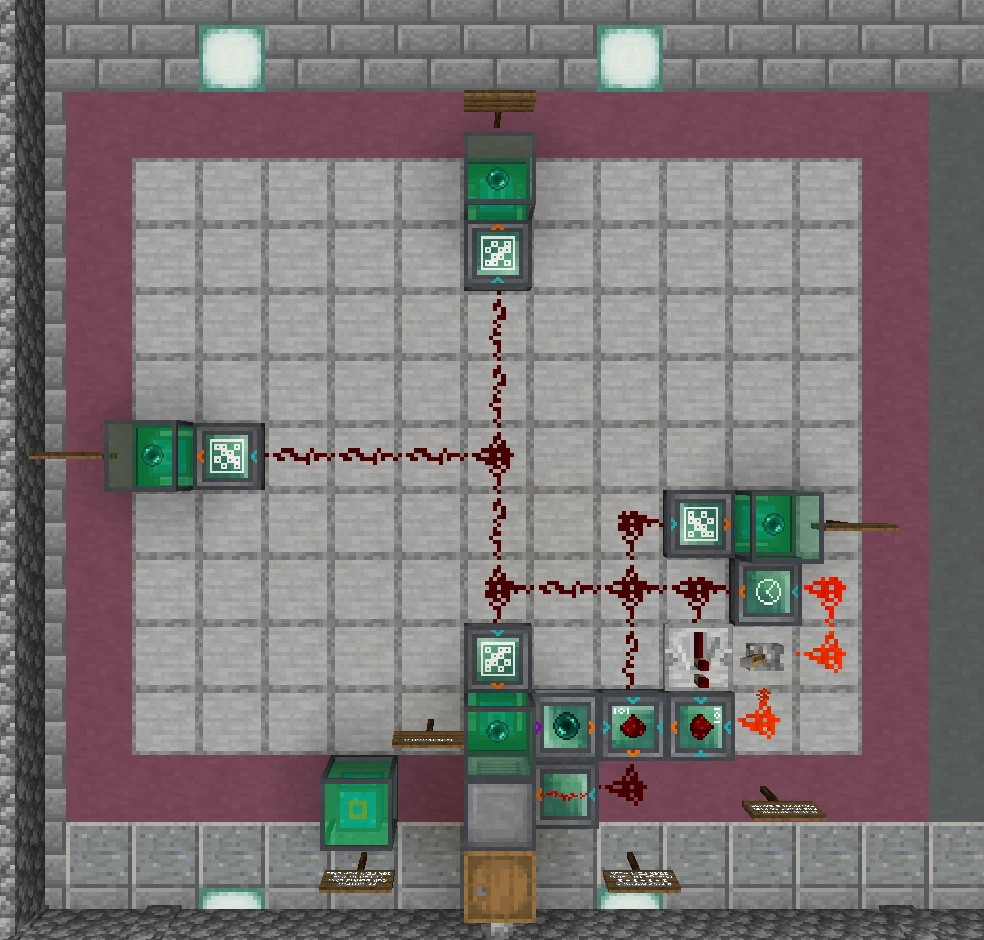
   X  -5 -4 -3 -2 -1  0 +1 +2 +3 +4 +5
 Z
-8     .  .  .  .  .  C  .  .  .  .  .
-7     .  .  .  .  .  S  .  .  .  .  .
-6     .  .  .  .  .  *  .  .  .  .  .
-5     .  .  .  .  .  *  .  .  .  .  .
-4     B  S  *  *  *  *  .  .  .  .  .
-3     .  .  .  .  .  *  .  *  S  D  .
-2     .  .  .  .  .  *  *  *  *  T  r
-1     .  .  .  .  .  S  .  *  R  L  r
 0     .  .  .  .  .  A  M  G  K  r  .
+1     .  .  .  P  .  I  W  *  .  .  .
Link A → B → C → D → A with 3, 3, 3, and 2 flight ticks. A fires at 0. B, C, and D catch and fire at 3, 6, and 9 respectively. A catches at 11 and fires at 12. The charge pulses land at 2, 5, 8, and 11. The shorter return fits a fourth catch into the same twelve-tick period.
Why A fires one tick later
RFTools updates the injector, then the generators in link order starting with A, then the Ender Monitor, Timer, and Sequencers. When a pearl reaches B, C, or D from an earlier generator in that order, the receiver can fire it during its own update on the same tick. The final generator delivers to A after A has already updated. A fires on its next update, before the game deducts holding energy for that tick.
Connect a load and test
- Put an Advanced Dimensional Cell directly under each generator and set its top face to input. The generator pushes FE into that face and keeps a 2,000 FE reserve when exporting.
- Give the input cells and outlet the same Powercell Card link. Insert an unlinked card to create the network, then copy that link to the other cards. Use a separate network for each build. Set the outlet faces attached to a load to output. The example uses the top, north, and south faces.
- Add ender pearls to the injector and unpower the lever. After the empty startup lap, the injector should spend a pearl and the generators should flash as they catch it. Hold a Smart Wrench and check Last pearl at 10 after the loop settles. The outlet's stored FE should rise when it has room.
If arrivals repeatedly fail, check the generator links and travel times in chat, then the Sequencer's Once2 mode, Delay 1, and enabled squares. If the injector runs on every clock pulse, check the monitor's Pearl Fired setting and the gate's fourth GUI row. When the storage is full, power the pause lever to conserve pearls.